
Click here for English
Pentecost XX
October 11th, 2026
Exodus 32:1-14 Philippians 4:1-9 Matthew 22:1-14
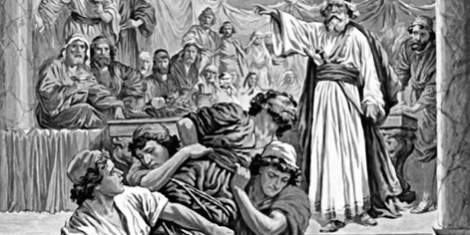
I have presided at some very strange weddings in my time, and as a priest, I’ve sat through my share of unusual receptions—usually parked at the table with the monolingual grandparents who need a running translation of the best man’s lurid reminiscences into French or English. But I don’t think I’ve ever attended a reception quite as bizarre as the one Jesus describes in Matthew’s Gospel. Two things in particular give me pause. First, the king’s invitation strategy. He sends his servants to invite the local nobility. When they turn him down—some of them inexplicably resorting to violence—the king sends an army to execute them and burn their city. I must say, I’m rather glad my own occasional RSVP regrets haven’t been met with artillery fire. Second, the maths at the end simply doesn’t add up. The king gathers everyone off the streets—both bad and good—and fills the banquet hall to capacity. Exactly one person is thrown out into the outer darkness for failing to wear the proper attire. Logically, we expect Jesus to conclude: “Many are called, one is turned away, but most of you will enjoy the feast.” Instead, Jesus delivers the punchline: “For many are called, but few are chosen.”
How can we make sense of these two curious and troubling elements in the parable? The context of the parable gives us a clue. The closer Jesus gets to Jerusalem, his comments about the Jewish religious authorities become more and more harsh. Here is an example: “Woe to you scribes and Pharisees, hypocrites! You traverse sea and land to make a single convert, and when he becomes a convert, you make him twice as much of a child of hell as yourselves! (Mat. 23) When we read the parable in this context, Jesus seems to be saying that the initial invitees to God’s banquet (the chosen people of God) have been passed over because of their stubbornness and their mistreatment of His messengers. Their rejected invitations have been passed on to the riff-raff, who are invited when the chosen people fail to show up. While this explanation gives us some historical context, it doesn’t lessen the harshness of judgment that we find in the parable. In this reading of the parable, we are the riff-raff. We are the B-list guests who have been invited to the wedding feast when all the other invitees have told the host that they have better plans on that day. Jesus has invited us to be his guests. The invitation is not based on any inherent merit that we have. We’ve not been invited because we are respectable, because we represent a good ethnic mix, because we have good qualifications, a noble ancestry, or even because we have suffered more than other people. We are invited because God has chosen to invite us – that is all we know.
But we are still left with the strange case of the inappropriately dressed invitee who is thrown out of the banqueting hall. Many people who preach on the themes of inclusivity and welcome in the church will tell you that once invited to God’s feast, it really doesn’t matter what you think or how you behave. Your unworthiness is irrelevant: the invitation is enough. That is only partly true. Once we receive our invitation, Jesus asks us to clean up and make ourselves ready for a wonderful party. He does not want us to stay as we were when he found us on the highways and byways. When he invited us, we were troubled, confused, sinful, sick or in deep distress. Perhaps we still are. But God loves us so much that he will not leave us unchanged. He wants none of us to remain in the gutter: just as the host of the party wanted his invitees to put off their old clothes and put on their wedding robes. Unless we are willing to take off the ragged clothes of despair, anger, arrogance, resentment, self-righteous pride or false modesty and to replace them with the wedding garments of faith, hope and love, we are not treating God’s invitation with the honor that it deserves. And here is a further clue. In near eastern antiquity, a monarch throwing a wedding feast provided the garments at the door. Everyone entered on equal footing. Crashing the king’s hall while refusing to put on his clothes wasn’t a fashion faux pas; it was an active insult. The man was thrown out because he wanted to participate in the King’s feast on his own terms. He scorned the provision of a new garment and refused the transformation that attending the feast required. But we are not left on our own to tidy ourselves up. The garment is ready. It will fit us perfectly; all the effort has been done by the King.
I find it helpful to remember that I am one of the rando riff-raff who is on the second tier of the invite list. I’m not here for my skill, my intelligence, my connections or my good looks. I’m a guest of a generous host – just as we all are. The ‘B’ list has become the ‘A’ list only because we have chosen to show up. And I’m comforted knowing that I should expect to hang out with all sorts of riff-raff at this same party, since I myself am one of the riff-raff invited at the last minute. I don’t expect my fellow invitees to behave impeccably. The Church is a big disappointment to people who are expecting to find a group of perfect people gathered in it. We are all a bunch of randos – but a bunch of randos that God loves.
The Internet is full of suggestions about how quickly you should reply to an invitation. The general advice is ‘As promptly as possible!’. A prompt response shows that you’re excited to be included in the event. The invitation to the party went out to everyone. God would love for you to be there. Get back to him as soon as you can. And don’t worry about the new clothes. The very fact that you are worried about what you might wear is a sign that you are already properly dressed. We leave self-doubt at the door. The host has already provided the clothes, the food, the wine and the company. The feast is ready when you are.
NJM
Le 20ᵉ dimanche après la Pentecôte 11 octobre 2026 Éxode 32, 1-14 | Philippiens 4, 1-9 | Matthieu 22, 1-14
J’ai célébré quelques mariages assez étranges au cours de ma carrière, et en tant que prêtre, j’ai accumulé pas mal d’heures de vol dans des réceptions hautes en couleur—souvent casé à la table des grands-parents unilingues qui ont besoin d’une traduction en direct des anecdotes gratinées du témoin. Mais je ne crois pas avoir jamais assisté à une fête aussi bizarre que celle décrite par Jésus dans l’Évangile de Matthieu. Deux éléments en particulier me laissent perplexe. D’abord, la stratégie d’invitation du roi. Il envoie ses serviteurs inviter la haute société locale. Quand ils déclinent—certains en devenant inexplicablement violents—le roi dépêche une armée pour les exécuter et brûler leur ville. Je dois dire que je suis plutôt soulagé que mes rares réponses négatives à des invitations n’aient jamais été accueillies par des tirs d’artillerie. Ensuite, le calcul à la fin ne tombe tout simplement pas juste. Le roi ramasse tous ceux qu’il trouve dans la rue—les bons comme les mauvais—et remplit la salle de banquet à craquer. Exactement une personne est jetée dans les ténèbres du dehors pour manque de tenue appropriée. Logiquement, on s’attendrait à ce que Jésus conclue : « Beaucoup sont appelés, un seul est renvoyé, mais la plupart d’entre vous profiterez bien du festin. » Au lieu de cela, Jésus nous lâche sa chute : « Car il y a beaucoup d’appelés, mais peu d’élus. »
Comment donner du sens à ces deux détails troublants ? Le contexte nous donne un indice. Plus Jésus s’approche de Jérusalem, plus ses propos envers les autorités religieuses deviennent sévères. Un exemple : « Malheur à vous, scribes et pharisiens hypocrites ! Parce que vous parcourez la mer et la terre pour faire un adepte ; et, quand il l’est devenu, vous en faites un fils de la géhenne deux fois plus que vous ! » (Matthieu 23). Lu dans cette optique, Jésus semble dire que les premiers invités du banquet de Dieu (son peuple élu) ont été ignorés en raison de leur entêtement et de leur violence envers ses messagers. Les invitations refusées ont été réattribuées aux gens du coin, ramassés au hasard quand les invités d’honneur ont fait faux bond.
Même si cette explication apporte un éclairage historique, elle n’adoucit pas la dureté du jugement. Dans cette lecture de la parabole, les gens du coin, c’est nous. Nous sommes les invités de la liste B, conviés parce que tous les autres avaient « un truc plus important prévu ce jour-là ». Jésus nous invite à sa table sans le moindre mérite de notre part. Nous ne sommes pas là parce que nous sommes fréquentables, parce que nous représentons une belle diversité, parce que nous avons de super diplômes, une noble lignée, ou même parce que nous avons plus souffert que les autres. Nous sommes invités parce que Dieu a choisi de nous inviter—et c’est tout ce qu’on sait. Mais il reste le cas étrange de cet invité mal fringué, jeté dehors. Beaucoup de prédicateurs qui s’expriment sur l’inclusivité et l’accueil vous diront qu’une fois invité au festin de Dieu, peu importe ce que vous pensez ou la façon dont vous vous conduisez. Votre indignité n’a aucune importance : l’invitation suffit.
Ce n’est qu’à moitié vrai. Une fois l’invitation reçue, Jésus nous demande de nous faire beaux et de nous préparer pour une fête magnifique. Il ne veut pas que nous restions tels qu’il nous a trouvés au bord des chemins. Quand il nous a invités, nous étions désemparés, confus, pécheurs, malades ou en grande souffrance. Nous le sommes peut-être encore. Mais Dieu nous aime trop pour nous laisser inchangés. Il ne veut pas que nous restions dans le ruisseau—tout comme l’hôte de la fête voulait que ses invités enlèvent leurs vieux habits pour revêtir des habits de noces. À moins d’être prêts à quitter les haillons du désespoir, de la colère, de l’arrogance, du ressentiment, de l’autosatisfaction ou de la fausse modestie, pour les remplacer par les vêtements de noces que sont la foi, l’espérance et l’amour, nous ne traitons pas l’invitation de Dieu avec l’honneur qu’elle mérite.
Et voici un autre indice : dans l’Antiquité au Proche-Orient, un monarque qui organisait un banquet fournissait les vêtements à l’entrée. Tout le monde entrait sur un pied d’égalité. Débarquer dans la salle du roi en refusant de porter ses vêtements n’était pas un faux pas vestimentaire ; c’était une insulte caractérisée. Cet homme a été jeté dehors parce qu’il voulait participer au festin du Roi selon ses propres conditions. Il a méprisé le vêtement offert et refusé la transformation qu’exigeait sa présence au festin. Mais on ne nous demande pas de nous débarbouiller tout seuls : le vêtement est prêt, il est à notre taille exacte, et le Roi a déjà tout accompli.
Pour ma part, ça me fait du bien de me rappeler que je fais partie de ces « pièces rapportées », issus du second choix de la liste d’invités. Je ne suis pas ici pour mes compétences, mon intelligence, mes relations ou mon physique avantageux. Je suis l’invité d’un hôte généreux—exactement comme vous tous. La liste B est devenue la liste A simplement parce que nous avons choisi de venir. Et cela me rassure de savoir que je vais croiser toutes sortes de lascars à cette fête, puisque je suis moi-même un oiseau rare invité à la dernière minute.
Je n’attends pas de mes compagnons de table qu’ils se comportent de manière irréprochable. L’Église est une grande déception pour ceux qui s’attendent à y trouver un rassemblement de personnes parfaites. Nous sommes tous une bande de gens du dimanche—mais une bande de gens du dimanche que Dieu aime profondément.
Internet regorge de conseils sur le délai idéal pour répondre à une invitation. La règle générale est : « Le plus vite possible ! ». Une réponse rapide montre que vous êtes ravi d’être de la partie. L’invitation a été lancée à tout le monde. Dieu aimerait tellement que vous soyez là. Répondez-lui sans tarder. Et ne vous inquiétez pas pour la tenue. Le fait même de vous soucier de ce que vous allez porter est le signe que vous êtes déjà habillés comme il faut. Laissons nos doutes à la porte. L’hôte a déjà tout prévu : les habits, le repas, le vin et la compagnie. Le festin est prêt, il n’attend plus que vous.