
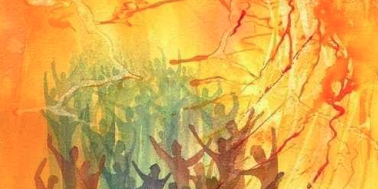
Pentecost
May 24, 2026
Acts 2 :1-21 I Corinthians 12 :3-13 John 20 :19-23
This time last week, we were celebrating the New York State Sacred Spaces open house. It was a beautiful day, and one of the highlights for me was a table at the front of the church with old photos and documents from our history. A photo from the 50’s or 60’s triggered a memory from my first visit here in September 1993, thanks to my predecessor, the Rev. Jim Harkins. He told me that once upon a time, the crossbeam above our altar proudly displayed the French inscription: “Dieu est Esprit.” Now, being more or less logical, I assumed that someone must have thought, “Well, we are the Church of St. Esprit, so let’s use the verse In John’s gospel where Jesus talks about God being Spirit.” A straightforward case of 1950’s ‘branding’. But I was wrong. Apparently, the verse was drawn from Paul’s second letter to the Corinthians: “The Lord is Spirit, and where the Spirit of the Lord is, there is freedom.” It was a deliberate nod to our founding Huguenots, who were chased out of France and relied on the Spirit to guide them to America for the very literal religious freedom to worship as they chose.
So, why isn’t it still up there? Because yet another one of my predecessors decided to take up interior design and have it painted over in the 1970s. I asked the Rev. Harkins why he did that. He thought the verse was “too abstract,” he said. Not Christ-centric enough, and practically Deist—as if leaving “God is Spirit” on the wall would accidentally turn the congregation into a bunch of Enlightenment philosophers worshiping a nebulous, cosmic muse. He thought that a monument to American Freedom had become a theological no-no.
There is something about this Holy Spirit. It has been understood in two contrasting ways throughout Christian history. We have felt the Spirit to be very near, and yet distant at the same time. The Spirit is uniquely close to us – like our breath or our very lives. And yet at the same time, the Spirit is anonymous, enigmatic and elusive. It can’t be controlled or classified, and is constantly breaking though historical, cultural, or personal barriers that we humans love to set up for ourselves. Jesus told us this. ‘The Spirit is like the wind. It blows where it wills.’ We feel that we know the Spirit, but we feel that we don’t know the Spirit at the same time. We never see the Spirit’s face, because the Spirit only has the face of Christ. Jesus says, ‘The Spirit will take what is mine, and he will show it to you.’ Over the years, Christians have sometimes turned the Spirit into something abstract and vague (like the story of ‘Dieu est Esprit’ that I told earlier), or something very emotional and immediate – a charismatic force that causes people to fall over in church because they are ‘slain in the Spirit’; they manifest very public gifts or babble in unknown tongues.
So, where does this leave us on our feast day as the French Church of the Holy Spirit? Should the inscription on the crossbeam still be there? What we can say is that the Holy Spirit is called upon and is present in the major sacraments of our common life: our baptism, confirmation, and (as we saw recently) at Joris’ ordination. We know that that the Holy Spirit is called to sanctify the gifts of bread and wine at this table, to make Christ present to us. The Spirit is the animating force that makes these sacred things real and present to us. Patriarch Ignatius IV of Antioch (1920–2012) was born and died in Lebanon, but he had a global reach. He fluently bridged worlds in Arabic, French and English, and he was deeply inspired by his time in France to do something quite radical: to rescue the Greek Orthodox faith from what he thought was its cultural ghetto. He didn’t want a fossilized cultural religion; he wanted living, breathing answers to modern-day problems. How did he set about it? By invoking the Holy Spirit.
Here is how he put it: ‘Without the Spirit God is far away. Christ is in the past. The gospel is a dead letter. The church is a mere organization. Authority becomes domination. Mission becomes propaganda. Worship is reduced to bare emotional recollection. Christian action becomes mere morality. But in the Spirit, by virtue of our unbreakable cooperation with him, God is near. The risen Christ is present with us. The gospel is the power of life. The Church becomes communion. Authority becomes liberating service. Mission is an expression of Pentecost. Liturgy makes the present both past and future. Human action is divinized and flows in love. The Spirit creates relationship and puts us in touch with God and each other. The Holy Spirit turns ‘then’ into ‘now’.
His words are equally at home in a charismatic church or a church with a deep, or even a Huguenot Protestant tradition. My prayer and my hope as we prepare for our four-hundredth anniversary is that we – as the French Church of St. Esprit – will keep on learning how to live into that vision. We are going to try to turn the ‘then’ into ‘now’, and perhaps we will return to the Patriarch’s words over the next two years. Here is a final prayer invoking that Spirit from St. Symeon (d. 1022) ‘Come, true light. Come, life eternal. Come, treasure without name. Come, rejoicing without end. Come, light that knows no evening. Come, the resurrection of the dead. Come, all-powerful, for unceasingly you create, refashion and change all things. You cannot remain hidden, for you fill all things with your glory. Stay with me; do not leave me alone. At my departure from this life and afterwards, may I be found in you and reign with you, who are God over all.’ Amen
NJM
Pentecôte 24 mai 2026 Actes 2 : 1-21 | I Corinthiens 12 : 3-13 | Jean 20 : 19-23
Le week-end dernier, à la même heure, nous fêtions les journées portes ouvertes des lieux sacrés de l’État de New York (New York State Sacred Spaces). C’était une magnifique journée. L’un des moments forts pour moi a été de découvrir, à l’entrée de l’église, une table couverte de vieilles photos et de documents d’archive. Une photo des années 50 ou 60 a réveillé en moi le souvenir de ma toute première visite ici, en septembre 1993, grâce à mon prédécesseur, le révérend Jim Harkins. Il m’avait raconté qu’autrefois, la poutre transversale au-dessus de notre autel arborait fièrement cette inscription en français : « Dieu est Esprit ».
Étant quelqu’un de plutôt logique, j’avais d’abord supposé que quelqu’un s’était dit : « Tiens, puisque nous sommes l’église du Saint-Esprit, utilisons le verset de l’Évangile de Jean où Jésus dit que Dieu est Esprit. » Une simple opération de communication des années 1950, en somme. Mais je me trompais. Apparemment, ce verset était tiré de la deuxième lettre de Paul aux Corinthiens : « Le Seigneur est l’Esprit, et là où est l’Esprit du Seigneur, là est la liberté. » C’était un clin d’œil délibéré à nos fondateurs huguenots qui, chassés de France, s’en étaient remis à l’Esprit pour les guider jusqu’en Amérique, afin d’y trouver la liberté religieuse, au sens le plus littéral, de pratiquer leur culte comme ils l’entendaient.
Alors, pourquoi cette inscription n’est-elle plus là ? Parce qu’un autre de mes prédécesseurs s’est improvisé décorateur d’intérieur et a décidé de la faire repeindre dans les années 1970. J’ai demandé au révérend Harkins pourquoi il avait fait cela. Selon lui, ce verset était « trop abstrait ». Pas assez centré sur le Christ, et presque déiste — comme si le fait de laisser « Dieu est Esprit » sur le mur risquait de transformer accidentellement la paroisse en un club de philosophes des Lumières vénérant une muse cosmique et nébuleuse. Pour lui, ce monument à la liberté américaine était devenu une sorte d’infraction théologique.
Il y a décidément quelque chose de singulier avec ce Saint-Esprit. Tout au long de l’histoire chrétienne, on l’a appréhendé de deux manières. Nous l’avons ressenti comme étant à la fois tout proche et lointain. L’Esprit nous est intimement lié – comme notre propre souffle ou notre propre vie. Et pourtant, en même temps, il reste anonyme, énigmatique et insaisissable. On ne peut ni le contrôler ni le classifier, et il passe son temps à briser les barrières historiques, culturelles ou personnelles que nous, les humains, aimons tant dresser. Jésus nous l’a déjà dit : « L’Esprit est comme le vent, il souffle où il veut. » Nous avons le sentiment de connaître l’Esprit, tout en ayant l’impression de ne pas le connaître. Nous ne voyons jamais le visage de l’Esprit, car l’Esprit n’a d’autre visage que celui du Christ. Jésus dit d’ailleurs : « Il prendra de ce qui est à moi, et il vous le dévoilera. »
Au fil des siècles, les chrétiens ont parfois transformé l’Esprit en quelque chose d’abstrait et de vague (comme dans l’histoire du « Dieu est Esprit » que je viens de vous raconter), ou au contraire en quelque chose de très émotionnel et d’immédiat — une force charismatique qui fait s’effondrer les gens sur les bancs de l’église parce qu’ils sont « terrassés par l’Esprit », ou qui les pousse à manifester des dons très spectaculaires ou à parler en langues.
En ce jour de fête, où cela nous mène-t-il, nous, l’Église Française du Saint-Esprit ? L’inscription sur la poutre devrait-elle encore y être ? Ce que nous pouvons affirmer, c’est que le Saint-Esprit est invoqué et présent dans les grands sacrements qui rythment notre vie communautaire : notre baptême, notre confirmation et (comme nous l’avons vu récemment) l’ordination de Joris. Nous savons que le Saint-Esprit est appelé pour sanctifier le pain et le vin à cette table, afin de rendre le Christ présent parmi nous. L’Esprit est la force animatrice qui rend ces choses sacrées réelles et actuelles pour nous.
Le patriarche Ignace IV d’Antioche (1920–2012) est né et mort au Liban, mais son action était mondiale. Il jetait avec fluidité des ponts entre les cultures en arabe, en français et en anglais. Son séjour en France l’a profondément inspiré à tenter un geste radical : sortir la foi orthodoxe grecque de son propre ghetto culturel. Il ne voulait pas d’une religion culturelle fossilisée ; il voulait des réponses vivantes et vibrantes aux problèmes d’aujourd’hui. Comment s’y est-il pris ? Il a invoqué le Saint-Esprit. Voici ses mots : « Sans l’Esprit, Dieu est loin, le Christ reste dans le passé, l’Évangile est une lettre morte, l’Église une simple organisation, l’autorité une domination, la mission une propagande, le culte une simple évocation émotionnelle, et l’action chrétienne une morale de pure forme. Mais dans l’Esprit, et grâce à notre indéfectible coopération avec lui, Dieu est proche, le Christ ressuscité est présent, l’Évangile est une force de vie, l’Église devient communion, l’autorité se fait service libérateur, la mission devient un écho de la Pentecôte, la liturgie actualise le passé et anticipe l’avenir, et l’action humaine, divinisée, rayonne d’amour. L’Esprit crée le lien, il nous met en communion avec Dieu et les uns avec les autres. Le Saint-Esprit transforme le “jadis” en “aujourd’hui”. »
Ses paroles résonnent tout autant dans une église charismatique que dans une église forte d’une longue tradition, même protestante huguenote. Alors que nous préparons notre quatre-centième anniversaire, ma prière et mon espoir sont que nous — en tant qu’Église Française du Saint-Esprit — continuions à apprendre à incarner cette vision. Nous allons nous efforcer de transformer le « jadis » en « aujourd’hui », et nous reviendrons peut-être aux paroles du Patriarche dans les années à venir.
Terminons par une dernière prière de saint Syméon (mort en 1022) invoquant cet Esprit : « Viens, lumière véritable. Viens, vie éternelle. Viens, trésor sans nom. Viens, joie sans fin. Viens, lumière sans déclin. Viens, résurrection des morts. Viens, ô Tout-Puissant, toi qui sans cesse crées, refçonnes et transformes toutes choses. Tu ne peux rester caché, car tu remplis tout de ta gloire. Demeure avec moi, ne me laisse pas seul. Qu’à l’heure de quitter cette vie et pour l’éternité, je sois trouvé en toi et règne avec toi, toi qui es Dieu au-dessus de tout. Amen. »