
The Epiphany
January 4, 2026
Isaiah 60:1-6 Ephesians 3:1-12 Matthew 2:1-12
The story of the visit of the Magi to Jesus is an ideal place to start when exploring Ignatian spirituality and its way of interpreting the bible. The method is easy to remember. Broadly speaking, it has six steps. (1) Still your mind. Pray for grace to see what God wants you to see in the passage. (2) Use your imagination. Put yourself in the place of someone in the story. How would you feel or react in their place? (3) Use all your senses. What can you see? What are the sounds and the smells like? (4) Reflect on what you have uncovered in this process. Did you discover something new? (5) Do any of these insights change the way in which you will relate to others, or to yourself? (6) Conclude with a prayer.
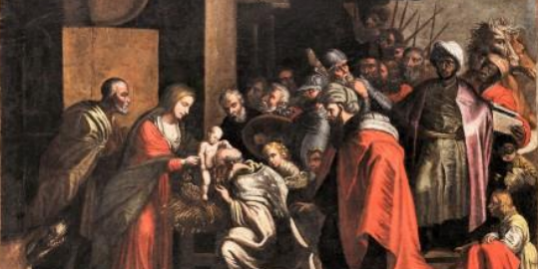
It is a good exercise for this reading from Matthew. It’s a strange story, and fires our imagination from the start. All our senses are implicated. The clothes of Mary and Joseph and the robes of the Magi, the smells of frankincense and myrrh in the stable. The sounds of the animals, the foreign accents of the visitors and the murmuring of the parents. The roughness of the straw and the warmth of so many gathered people in a small space. The only sense that’s difficult to engage is taste, since these Magi didn’t bring anything to eat. Perhaps the story gives us an insight into humility, or how we welcome strangers, what we might offer the Christ child, or how we see the presence of the divine in unexpected places or in unforeseen circumstances.
The story has inspired many artists, poets, novelists and composers. It has also inspired lots of jokes along the lines of ‘What if the Three Wise Men had been Three Wise Women?’ Frivolous as they might be, these jokes reveal our attitudes towards the people and the social norms of our own times. Here’s one I made up for the occasion: What would have happened if the Magi had been social media influencers? They’d follow the star on Google Maps, argue over who gets credit in the Instagram collab, and stay for two weeks to do multiple reshoots of the gift unboxing videos. Gold would be sponsored by Tiffany, frankincense would be an affiliate link, the mention of myrrh would get them demonetized on YouTube, and the baby would already have a verified account before the shepherds can even hit “like.” You can make up your own jokes along the same lines (what if they had been lawyers? Accountants? MAGA supporters?)
There is nothing new in this way of looking at the story, even though these joke versions are probably more frivolous than helpful. At the time of Jesus, their visit to the Christ child – and their being welcomed by Mary and Joseph into his presence – borders on the scandalous. They were impure foreigners. Jewish law usually meant that only close relatives would be admitted into the presence of a woman who had just given birth. Even more seriously, they were Magi. Their search for the special child wasn’t based on an interpretation of the Hebrew prophets like Isaiah or Micah. They were diviners like the Babylonians, who interpreted the messages written in the skies through celestial phenomena such as the movement of the planets or the shape of comets. The Magi are supposed to fire our imaginations and make us wonder what on earth will happen next in this strange story.
What stands out in all these interpretations – including the humorous ones – is that these Magi represent us all. There is a universality to them that goes beyond the borders of Judea or Palestine, and breaks the social norms of any specific time or culture. One of the oldest of these interpretations concerns the ages of the Magi. What did they mystically perceive when they looked into the face of Jesus? The first was a young man. He offered shining gold. When he looked into the manger he saw the face of a young prince with the promise of a bright future before him. The second was a middle-aged man at the height of his powers. He offered frankincense, whose perfume rises to heaven in the temple sacrifices. When he looked into the manger he was dazzled by the image of a wise magician who held the world in his hands. The third was an old man. He offered myrrh; the loving perfume that accompanies the embalming of a person whose life has been well-lived. When he looked into the manger, he saw the face of a wise and experienced magician, lined with all the cares and woes of the world, and yet radiating peace. This early medieval reading of the story points us to the fact that every age has its beauty and its own special insights into the mystery of the Nativity.
What we choose to read into the story can tell us a great deal about how we judge others, and how we impose our ideals or values on them. We do this for many reasons – self-defense, a desire to construct the world in our own image, a selfish desire to protect our own interests. Perhaps we are simply too afraid to take a risk or to discover something new. Our society judges people by their race or gender. We judge members of our own family, our co-workers, our friends or the people we worship with on a Sunday. The Epiphany urges us to listen to the true voices of these people, to acknowledge their fears and their hopes and to let them teach us something new and unexpected about the world and about ourselves.
Let us conclude with a last look at the Magi. They cannot have been expecting what they found. Their gifts were appropriate to a powerful ruler and magician, not to the King of Love, born humbly in a stable. Did what they find surpass or fall short of their expectations? We simply do not know. Neither do we know what happened to them once they left Bethlehem. All we can say for certain is that they left their gifts in the stable because they believed that they had found what they sought. Their willingness to let go of their gifts in the presence of Christ makes them the first in a long line of strangers like ourselves, whose view of the world has been transformed by the unexpected light of the first Christmas.
NJM
L’Épiphanie 4 janvier 2026 Isaïe 60, 1-6 Éphésiens 3, 1-12 Matthieu 2, 1-12
L’histoire des mages qui rendent visite à Jésus est un point de départ idéal si vous souhaitez explorer la spiritualité ignatienne et sa manière d’interpréter la Bible. La méthode est facile à retenir. En gros, elle comporte six étapes. (1) Calmez votre esprit. Priez pour avoir la grâce de voir ce que Dieu veut que vous voyiez dans le passage. (2) Faites appel à votre imagination. Mettez-vous à la place d’un personnage de l’histoire. Comment vous sentiriez-vous ou réagiriez-vous à leur place ? (3) Utilisez tous vos sens. Que voyez-vous ? Quels sont les sons et les odeurs ? (4) Réfléchissez à ce que vous avez découvert au cours de ce processus. Avez-vous découvert quelque chose de nouveau ? (5) Ces découvertes changent-elles la façon dont vous vous comportez avec les autres ou avec vous-même ? (6) Terminez par une prière.
C’est un bon exercice pour cette lecture de Matthieu. C’est une histoire étrange, qui stimule notre imagination dès le début. Tous nos sens sont sollicités. Les vêtements de Marie et Joseph et les robes des mages, les odeurs d’encens et de myrrhe dans l’étable. Les bruits des animaux, les accents étrangers des visiteurs et les murmures des parents. La rugosité de la paille et la chaleur de tant de personnes rassemblées dans un petit espace. Le seul sens difficile à solliciter est le goût, car ces mages n’ont rien apporté à manger. Peut-être que cette histoire nous donne un aperçu de l’humilité, de la manière dont nous accueillons les étrangers, de ce que nous pourrions offrir à l’enfant Jésus, ou de la façon dont nous percevons la présence du divin dans des lieux inattendus ou dans des circonstances imprévues.
Cette histoire a inspiré de nombreux artistes, poètes, romanciers et compositeurs. Elle a également inspiré de nombreuses blagues du type « Et si les trois rois mages avaient été trois reines mages ? ». Aussi frivoles soient-elles, ces blagues révèlent notre attitude envers les gens et les normes sociales de notre époque. En voici une que j’ai inventée pour l’occasion : Que se serait-il passé si les mages avaient été des influenceurs sur les réseaux sociaux ? Ils auraient suivi l’étoile sur Google Maps, se seraient disputés pour savoir qui serait crédité dans la collaboration Instagram et seraient restés sur place deux semaines pour faire plusieurs prises des vidéos d’ouvertures des cadeaux. L’or serait sponsorisé par Tiffany, l’encens serait un lien affilié, la mention de la myrrhe leur vaudrait d’être démonétisés sur YouTube, et le bébé aurait déjà un compte vérifié avant même que les bergers aient pu cliquer sur « J’aime ». Vous pouvez inventer vos propres blagues dans le même esprit (et s’ils avaient été avocats ? Comptables ? Partisans du mouvement MAGA ?)
Il n’y a rien de nouveau dans cette façon d’aborder l’histoire, même si ces versions humoristiques sont probablement plus frivoles qu’utiles. À l’époque de Jésus, leur visite à l’enfant Jésus – et le fait qu’ils aient été accueillis par Marie et Joseph en sa présence – frôle le scandaleux. C’étaient des étrangers impurs. La loi juive stipulait généralement que seuls les proches parents pouvaient être admis en présence d’une femme qui venait d’accoucher. Plus grave encore, ils étaient des mages. Leur recherche de l’enfant spécial ne reposait pas sur une interprétation des prophètes hébreux comme Isaïe ou Michée. C’étaient des devins comme les Babyloniens, qui interprétaient les messages écrits dans le ciel à travers des phénomènes célestes tels que le mouvement des planètes ou la forme des comètes. Les mages sont censés stimuler notre imagination et nous faire nous demander ce qui va bien pouvoir se passer ensuite dans cette étrange histoire.
Ce qui ressort de toutes ces interprétations, y compris les plus humoristiques, c’est que ces mages nous représentent tous. Ils ont un caractère universel qui dépasse les frontières de la Judée ou de la Palestine et brise les normes sociales de toute époque ou culture spécifique. L’une des plus anciennes de ces interprétations concerne l’âge des mages et ce qu’ils ont perçu mystiquement lorsqu’ils ont regardé le visage de Jésus. Le premier des mages était un jeune homme. Il a offert de l’or brillant. En regardant dans la crèche, il vit le visage d’un jeune prince promis à un brillant avenir. Le deuxième était un homme d’âge mûr, au sommet de sa puissance. Il offrit de l’encens, dont le parfum monte vers le ciel lors des sacrifices au temple. En regardant dans la crèche, il fut ébloui par l’image d’un magicien parfait et sage qui tenait le monde entre ses mains. Le troisième était un vieil homme. Il offrit de la myrrhe, le parfum d’amour qui accompagne l’embaumement d’une personne qui a bien vécu sa vie. Lorsqu’il regarda dans la crèche, il vit le visage d’un magicien sage et expérimenté, marqué par tous les soucis et les malheurs du monde, mais rayonnant néanmoins de paix. Cette interprétation médiévale de l’histoire nous montre que chaque époque a sa beauté et sa propre vision du mystère de la Nativité.
Ce que nous choisissons de lire dans cette histoire peut nous en apprendre beaucoup sur la façon dont nous jugeons les autres et dont nous leur imposons nos idéaux ou nos valeurs. Nous le faisons pour de nombreuses raisons : par autodéfense, par désir de construire le monde à notre image, par désir égoïste de protéger nos propres intérêts. Peut-être avons-nous simplement trop peur de prendre des risques ou de découvrir quelque chose de nouveau. Notre société juge les gens en fonction de leur race ou de leur sexe. Nous jugeons les membres de notre propre famille, nos collègues, nos amis ou les personnes avec lesquelles nous prions le dimanche. L’Épiphanie nous invite à écouter la voix authentique de ces personnes, à reconnaître leurs craintes et leurs espoirs, et à les laisser nous enseigner quelque chose de nouveau et d’inattendu sur le monde et sur nous-mêmes.
Terminons par un dernier regard sur les mages. Ils ne pouvaient pas s’attendre à ce qu’ils ont trouvé. Leurs cadeaux convenaient à un puissant souverain et magicien, pas au Roi de l’Amour, né humblement dans une étable. Ce qu’ils ont trouvé a-t-il dépassé ou déçu leurs attentes ? Nous ne le savons tout simplement pas. Nous ne savons pas non plus ce qui leur est arrivé après leur départ de Bethléem. Tout ce que nous pouvons affirmer avec certitude, c’est qu’ils ont laissé leurs cadeaux dans l’étable parce qu’ils croyaient avoir trouvé ce qu’ils cherchaient. Leur volonté de renoncer à leurs cadeaux en présence du Christ fait d’eux les premiers d’une longue lignée d’étrangers comme nous, dont la vision du monde a été transformée par la lumière inattendue du premier Noël.
NJM