
Trinity Sunday
May 31, 2026
Genesis 1:1-2:4 II Corinthians 13:11-13 Matthew 28:16-20
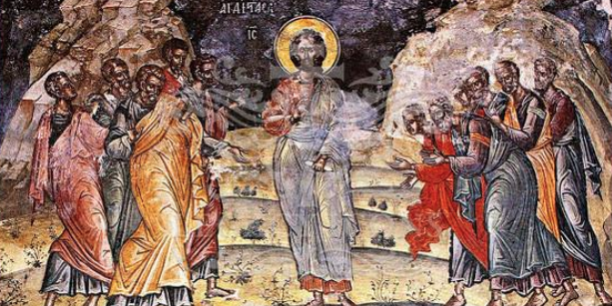
Our Gospel reading today brings us to the very end of the book of Matthew. Just before this passage, an angel and then Jesus himself appeared to the women near the empty tomb on the outskirts of Jerusalem. Jesus repeated the message the angel had already given them: “Do not be afraid. Go and tell my brothers to go to Galilee; there they will see me.” So, this morning, we find ourselves in Galilee with the eleven disciples who went there following the instructions that the women had given them. There, when they see the risen Jesus on the mountain he had directed them to, “they worshiped him.” But Matthew adds, “yet some doubted.” What do you think they were doubting? There is so much in Jesus’ ministry and identity that was bound to turn the beliefs of first-century Galilean Jews completely upside down. And what he adds to his final words doesn’t fit at all into the respectable cultural, economic, or religious world of his disciples.
Jesus comes forward, Matthew tells us, and says to them: “All authority in heaven and on earth has been given to me. Go therefore and make disciples of all nations, baptizing them in the name of the Father and of the Son and of the Holy Spirit, and teaching them to obey everything that I have commanded you.” What is Jesus telling them here? I think there are three main things to consider. First, he presents himself to them—he, the man and Son of God—as the cosmic king, the one who holds all authority over the entirety of creation: the new human. He truly fulfills God’s promise made to humanity at Creation: to be the true, living image of the Creator. Jesus unites heaven and earth, just as God intended in the beginning when he created humanity in his image. It was a difficult reality to grasp for a first-century Galilean—and it remains a challenge for us today—that this specific man, at a precise moment in history, could be the firstborn of a brand-new reality where God and humanity are reconciled. But that is exactly where Jesus’ words connect to the disciples; and to us. This is the second point, and it’s the heart of this sending. The reconciling authority of Jesus—the authority he won by passing through life and death the way he did—is not his exclusive domain. His power, like that of the Creator Father and the human made in his image, is generous and overflowing. Jesus wants to bring life to the whole world. Not just to this or that person, not just to people like this or like that, but to the entire creation—offering it the same life he has, a life over which death no longer has any hold. And that is where the disciples – where we – come into play. By participating in the life of God—a living, generous God whom we recognize in the Trinity (Father, Son, and Holy Spirit), a God who is relationship itself and unfathomable diversity—we can participate in bringing life back to the world, to our families, and to the society in which we live. This happens through relationship, through passing it on. It’s about sharing our intimacy with Jesus; the intimacy that the first community of disciples experienced, which has been handed down to us in this Gospel. “Teaching them to obey everything that I have commanded you,” Jesus says. Jesus doesn’t send his disciples out—he doesn’t send us out—without provisions for the journey, without a framework, a roadmap, or a method for this new creation. But where do we find these commandments? Throughout the Gospel of Matthew, which is structured into five “discourses,” mirroring the five books of Moses. The life of Jesus and his teachings are a summary of the very spirit of God, a spirit he wants to impart to us so that we can live by it.
In the way Jesus lives, we see that he didn’t come to bring a new religion or a new tribal identity, but a disruptive invitation to enter into a whole new way of being with ourselves and with others. It is a way of being that infuses everything. Up on a mountain (Mt 5–7), Jesus called us to an internal transformation where our real motives matter more than our outward appearances. Aware of how difficult the world can be, he sent us into it (Mt 10), encouraging us to be shrewd in the face of danger and clear in our intentions. Examining our intentions and motives is already a way of letting the Gospel seep into us, making it tangible to those around us. This new reality, this “kingdom,” doesn’t impose itself by force. Jesus told us it grows inside us invisibly, like a hidden treasure or a pearl of great price for which it is worth giving up our whole life. (Mt 13). Time and again, we see that at the heart of this new community, Jesus breaks down barriers. In his kingdom, service is the true measure of greatness. It is our living relationship with God and others—not things, status, ideas, mistakes, or prejudices—that defines who we are. This new way of living is embodied in our capacity to forgive, moving forward while remaining clear-eyed about the past. Finally, before leaving his disciples to go to the cross (Mt 23–25), Jesus warns against religious, moral, and identity-driven hypocrisy by looking at the world from the perspective of the most vulnerable.
This is exactly what the disciples are sent to share with the world. It’s not a slogan; it’s not a brand identity. They aren’t sent to recruit members for a Christian country club called the Church. They are sent into the world—and that’s where we are too—to be the reflections of God, of Christ, by living out the path he traced for us. And striving to live this way, thanks to Christ who promised to be with us always in doing so, is evangelism. It is living out and sharing the good news of the kingdom through everything we are. This has major social and political implications in our lives—implications that cut to the very root of who we are. If we embody the Gospel, we cannot opt for an exclusionary, identity-driven vision of community, whether national or religious. We cannot mistreat foreigners—as we see happening in so many nations today—or look at newcomers and outsiders with suspicion. We cannot prioritize our own class interests over the community that unites us to the dignity of every other human being. Nor can we refuse to take responsibility for our actions, or fail to recognize with humility when we are taking up too much space. We have barely begun to measure the sheer scale, abundance, and generosity of this new way of being that Jesus calls us to and sends us out to spread. It is a way of being that seems completely upside down to a world in shambles, yet it is exactly what brings it order and peace. We often overlook the fact that this way of living expresses itself in very intimate ways, within our relationships and inside this community. It shows up every time we take care of one another, every time we willingly chip in to the work of the church by volunteering for tasks that might cost us something, or whenever we welcome—with the very same love the Triune God extends to us—every new person and every new obstacle we meet on our path.
JFAB
Dimanche de la Trinité 31 mai 2026 Genèse 1:1-2:4 II Corinthiens 13:11-13 Matthieu 28:16-20
Notre évangile d’aujourd’hui est la toute fin du livre de Matthieu. Juste avant notre passage, un ange puis Jésus lui-même sont apparus aux femmes près du tombeau vide, dans la banlieue de Jérusalem. Jésus leur a répété le message que l’ange avait déjà transmis : « N’ayez pas peur. Allez dire à mes frères de se rendre en Galilée : c’est là qu’ils me verront. » Ce matin, nous sommes donc en Galilée avec les onze disciples qui s’y sont rendus selon ce que les femmes leur avaient rapporté. Là, quand ils voient Jésus ressuscité sur une montagne qu’il leur avait indiquée, « ils se prosternent ». Mais « certains d’entre eux, pourtant, ont des doutes ». De quoi doutent-ils, croyez-vous ? Il y a beaucoup de choses dans le ministère et l’identité de Jésus qui ont de quoi mettre sens dessus-dessous les croyances de Juifs galiléens du premier siècle. Et ce qu’il ajoute dans ses dernières paroles ne le fait pas du tout rentrer dans le rang de ce qui est culturellement, économiquement ou religieusement respectable pour ses disciples.
Jésus s’approche, nous dit Matthieu, et leur dit : « Toute autorité m’a été donnée dans le ciel et sur la terre. Allez donc auprès des gens de tous les peuples et faites d’eux mes disciples ; baptisez-les au nom du Père, du Fils et de l’Esprit Saint, et enseignez-leur à pratiquer tout ce que je vous ai commandé. » Que leur dit Jésus en leur disant cela ? Trois choses à retenir je crois. D’abord, il se présente à eux, lui l’homme et Fils de Dieu, comme le roi cosmique, celui qui a toute autorité sur l’ensemble de la création, le nouvel humain. Il accomplit vraiment la promesse de Dieu faite à l’être humain quand il le crée : être l’image vraiment ressemblante du Créateur. Jésus réunit le ciel et la terre, comme le souhaitait Dieu au commencement lorsqu’il a créé l’être humain à son image. C’est une réalité difficile à accepter pour un galiléen du premier siècle, mais aussi pour nous aujourd’hui, que cet homme à un moment de l’histoire soit le premier né d’une nouvelle réalité où Dieu et l’humain sont réconciliés. Mais c’est là que ce que dit Jésus se rapporte justement aux disciples et à nous. C’est la deuxième chose qu’il leur dit, c’est le cœur de cet envoi. L’autorité réconciliatrice de Jésus, celle qu’il a acquise en traversant la vie et la mort comme il l’a fait, n’est pas son pré carré. Son pouvoir, comme celui du Père créateur et de l’humain créé à son image, est généreux et surabondant. Jésus veut faire vivre le monde entier, pas seulement tel ou tel, pas seulement les gens comme ci ou comme ça, mais la création entière comme lui, d’une vie sur qui la mort n’a plus d’emprise. Et c’est là que les disciples, que nous, nous entrons en jeu. En participant à la vie de Dieu, d’un Dieu vivant et généreux que nous reconnaissons dans la Trinité, Père, Fils et Saint-Esprit, c’est-à-dire un Dieu qui est relation, qui est une diversité insondable, nous pouvons participer à redonner vie au monde, à notre famille, à la société dans laquelle nous vivons. Ça se passe par la relation, par la transmission. La transmission de notre intimité à Jésus, celle que la communauté des premiers disciples a connue et qui s’est transmise dans cet évangile. « Enseignez-leur à pratiquer tout ce que je vous ai commandé » dit Jésus. Jésus n’envoie pas ses disciples, il ne nous envoie pas, sans provisions pour la route, sans forme, sans marche à suivre, sans méthode pour cette nouvelle création. Mais où trouve-t-on ces commandements ? Dans tout l’évangile de Matthieu, qui est structuré en cinq « discours » comme les cinq livres de Moïse. La vie de Jésus, ses enseignements, est un résumé de l’esprit même de Dieu qu’il veut nous communiquer et dont il veut que nous vivions.
Dans la manière dont Jésus vit, on voit qu’il ne vient pas apporter une nouvelle religion, une nouvelle identité communautaire, mais une invitation bouleversante à entrer dans une nouvelle façon d’être à soi-même et aux autres qui s’infuse partout. Monté sur une montagne, Jésus nous a appelés à une transformation intérieure où nos motivations réelles comptent plus que nos apparences. Conscient des difficultés du monde, il nous y a envoyé (Mt 10) nous encourageant à être sages face aux pièges et clairs dans nos intentions. Examiner nos intentions et motivations c’est déjà laisser l’évangile s’infiltrer en nous et le rendre sensible à ceux qui nous entourent. Cette nouvelle réalité, ce « royaume », ne s’impose pas par la force : il grandit en nous, nous a dit Jésus, de manière invisible, tel un trésor ou une perle rare qui vaut qu’on lui donne toute notre vie (Mt 13). On le voit encore et encore, au cœur de cette nouvelle communauté Jésus brise les barrières, car en son cœur c’est le service qui fait la vraie grandeur. C’est la relation vivant à Dieu et aux autres, pas des choses, pas des statuts, pas des idées, pas des erreurs, pas des préjugés qui définissent qui nous sommes. Cette façon nouvelle de vivre, elle s’incarne dans notre faculté de pardonner, à aller de l’avant conscient du passé. Enfin, avant de quitter ses disciples pour monter vers la croix (Mt 23-25), Jésus met en garde contre l’hypocrisie religieuse, morale, identitaire en prenant le point de vue des plus vulnérables.
Ce que les disciples sont envoyés communiquer au monde c’est cela. Ce n’est pas un slogan, ce n’est pas une identité. Ils ne sont pas envoyés pour créer les membres d’un club religieux chrétien qui serait l’Église. Ils sont envoyés dans le monde, nous y sommes, pour être les reflets de Dieu, du Christ, dans ce monde en vivant de la manière qu’il a tracée pour nous. Et vivre de cette manière, s’y efforcer, grâce au Christ qui a promis d’être toujours avec nous en cela, c’est évangéliser. C’est vivre, partager, par tout ce que nous sommes la bonne nouvelle du royaume. Cela a des implications sociales et politiques dans nos vies. Des implications qui vont à la racine de notre être. Si on incarne l’évangile, on ne peut pas préférer une vision identitaire ou fermée de la communauté, qu’elle soit nationale ou religieuse. On ne peut pas maltraiter les étrangers, comme on le voit dans beaucoup de nations aujourd’hui, ou regarder les nouveaux-venus ou les gens qui ne rentrent pas dans le moule d’un mauvais œil. On ne peut pas non plus préférer ses intérêts de classe à la communauté qui nous unit à la dignité de tous les autres êtres humains. On ne peut pas non plus refuser de prendre nos responsabilités ou reconnaître avec humilité que nous nous imposons trop. Nous n’avons pas fini de mesurer l’immensité et l’abondance, la générosité, de cette nouvelle façon d’être à laquelle Jésus nous appelle et qu’il nous envoie propager. Une façon d’être sens dessus dessous pour le monde en bazar qui lui apporte pourtant ordre et paix. On néglige souvent de voir que cette manière de vivre s’exprime de manière parfois très intime, au sein de nos relations, de cette communauté. Elle s’exprime à chaque fois que nous faisons attention les uns aux autres, que nous collaborons de bonne grâce à l’œuvre de l’église en nous portant volontaires pour faire parfois des choses qui nous coûtent, ou bien en accueillant avec le même amour que le Dieu trinitaire nous accueille en sa vie toute nouvelle personne, tout nouvel obstacle, que nous rencontrons.
JFAB